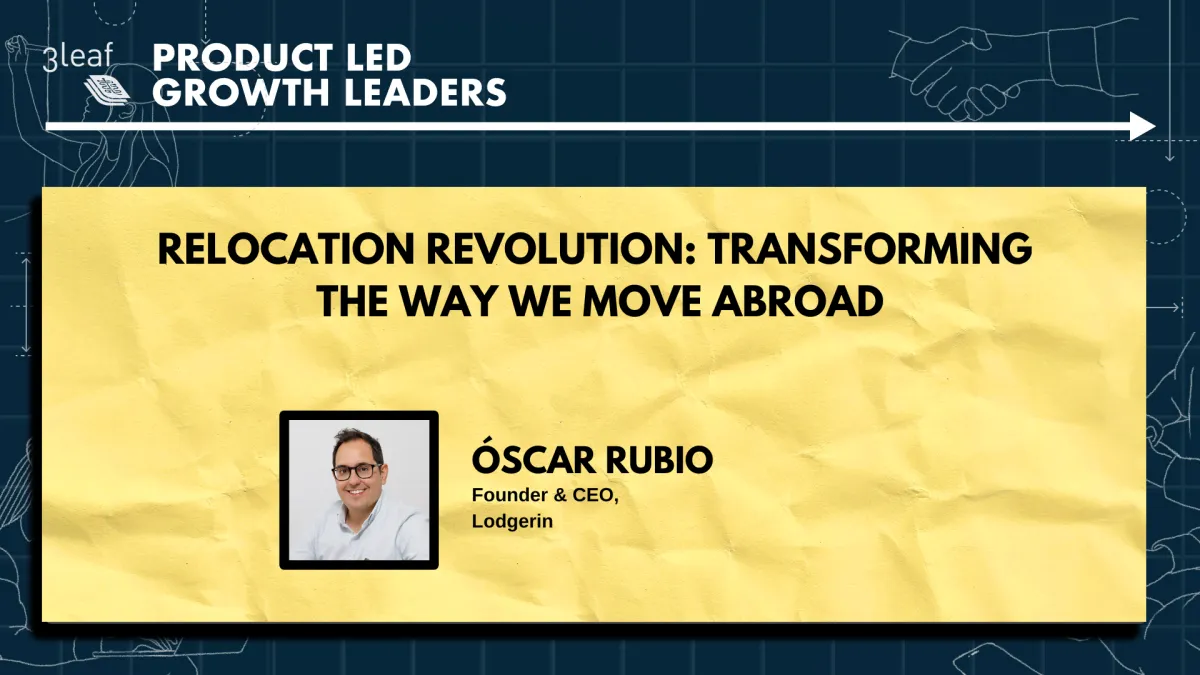
170 - Relocation Revolution: Transforming the Way We Move Abroad
Scaling Global Mobility: How Lodgerin Simplifies the International Relocation Maze
In this episode of Product Led Growth Leaders, host Thomas Watkins sits down with Óscar Rubio, the Founder and CEO of Lodgerin, to discuss the high-friction world of international relocation. Moving abroad is notoriously complex, involving a fragmented landscape of housing, legal bureaucracy, and administrative hurdles that can overwhelm even the most prepared individuals. Rubio shares how his company has transitioned from a traditional service model to a robust digital ecosystem, providing a seamless "all-in-one" experience for universities and corporations managing global mobility. This conversation is essential for leaders looking to understand how a product-led approach can solve deep operational inefficiencies in a traditionally manual industry.
Transforming Relocation through Centralized Digital Ecosystems
International relocation is fundamentally a process problem, and Rubio explains that the key to solving it lies in moving away from fragmented tools like spreadsheets and endless email chains. By building a unified platform, Lodgerin enables organizations to centralize every touchpoint—from securing vetted housing to opening local bank accounts—into a single dashboard. This shift doesn't just benefit the end-user; it provides administrators with the transparency and tracking necessary to manage large groups of students or employees with minimal overhead. The focus is on creating a "Blue Ocean" in the mid-term relocation market, targeting stays between one month and a year, where traditional short-term travel apps and long-term real estate services often fall short.
To achieve true scalability, the platform leverages a B2B-first strategy, partnering directly with institutions that have a vested interest in their members' success. This model allows for more efficient growth while providing a curated ecosystem of local service providers who are contractually bound to maintain high standards. As the platform evolves, the integration of automation and machine learning is set to further accelerate these processes, allowing the technology to handle data-heavy tasks while human support remains available for high-value, personalized needs. This balanced approach ensures that as an organization grows, the quality of the relocation experience remains consistent across different geographical markets.
For organizations currently supporting global talent, the path forward involves embracing local expertise combined with digital-first workflows. Rubio highlights that while the pain points of moving are universal, the solutions must be locally nuanced. Navigating the regulatory and cultural specifics of a city like Dubai or Paris requires on-the-ground knowledge that a purely digital tool cannot provide on its own. By marrying deep local partnerships with a streamlined user interface, institutions can offer their people peace of mind and operational excellence, ensuring that the focus remains on the purpose of the move—whether it be education or professional growth—rather than the stress of the transition.
About Óscar Rubio
Óscar Rubio is the Founder and CEO of Lodgerin, a digital platform revolutionizing the international relocation industry. Drawing from his own challenging experience as an expat, Óscar has dedicated his career to building technology-driven solutions that simplify global mobility for students and professionals.
About Lodgerin
Lodgerin is a leading relocation platform that partners with universities and multinational corporations to provide a comprehensive ecosystem of services. From housing and insurance to legal support and banking, the company specializes in mid-term stays, ensuring a secure and efficient transition for individuals moving across international borders.
Links Mentioned in This Episode
Key Episode Highlights
The Complexity of "Mid-Term" Relocation: Why the one-month to one-year stay window is a specialized market that requires more than just a travel app.
The B2B Scaling Advantage: How partnering with institutions creates a sustainable growth model compared to high-cost individual consumer acquisition.
Vetted Ecosystems vs. Open Markets: The importance of using contractually-bound local partners to ensure quality and accountability in a new country.
Digitalization of Bureaucracy: How moving away from "spreadsheet management" to a centralized dashboard reduces operational costs and administrative burnout.
The Role of AI in Global Mobility: Using automation to personalize the relocation journey and proactively solve problems before they occur.
Conclusion
This conversation underscores a vital lesson for any leader in the global mobility or HR space: technology is the ultimate lever for turning a stressful, manual process into a competitive advantage. By centralizing the relocation journey into a single, product-led platform, organizations can support their people more effectively while significantly reducing their own internal workload.
To learn more about how to align your product strategy with user-centric design and business goals, visit 3Leaf Consulting. If you are a leader in the SaaS or tech space with a story to tell, we’d love to hear from you—apply to be a guest on Product Led Growth Leaders here.